

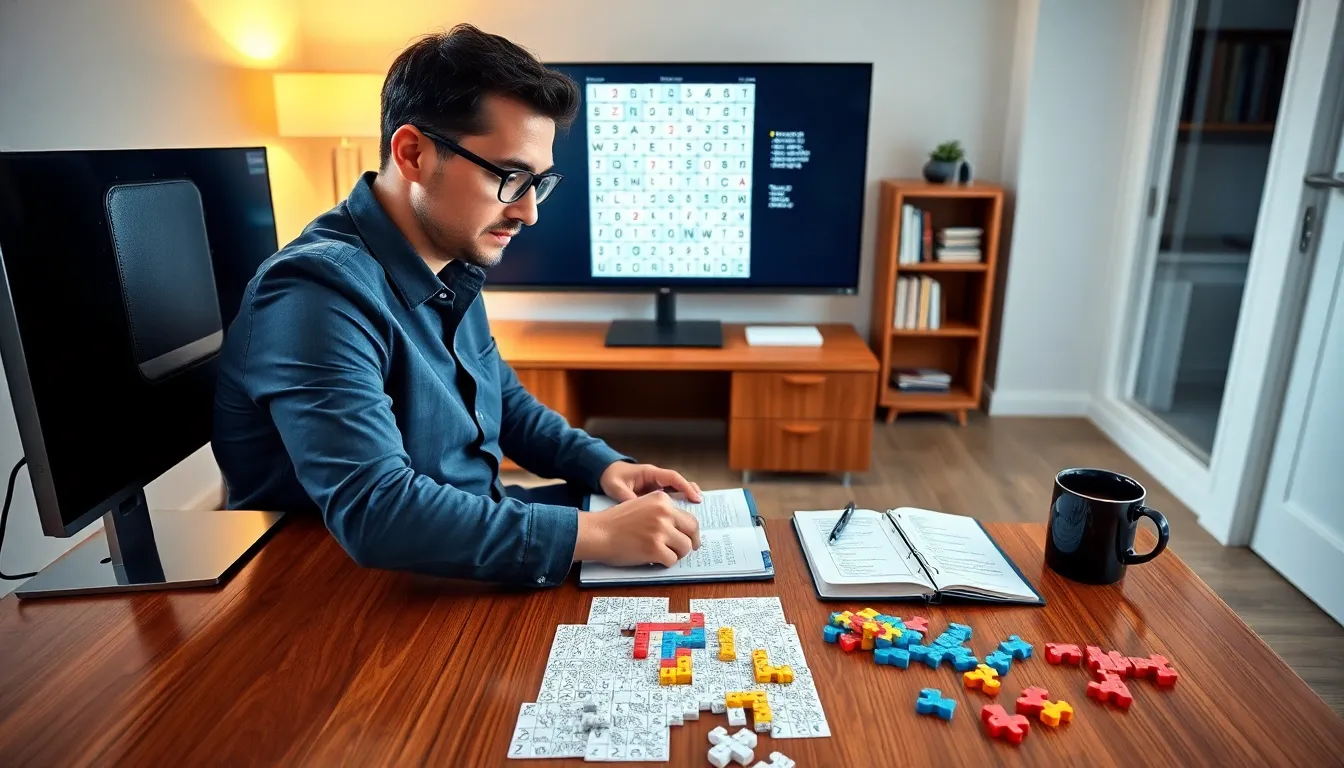
Puzzle games techniques separate casual players from true problem-solvers. Whether someone faces a cryptic crossword, a sliding tile challenge, or a brain-bending logic grid, the right strategies make all the difference. Puzzles test pattern recognition, logical thinking, and patience, skills that improve with practice and the right approach.
This guide breaks down proven puzzle games techniques that work across genres. Readers will learn how to spot patterns, apply elimination methods, and sharpen their solving speed. These strategies help players tackle everything from Sudoku to escape room challenges with confidence.
Table of Contents
ToggleKey Takeaways
- Mastering puzzle games techniques starts with identifying patterns and understanding the rules each puzzle follows.
- Use elimination and working backwards to narrow down possibilities and solve puzzles more efficiently.
- Break complex puzzles into smaller, manageable parts using a divide-and-conquer approach.
- Daily practice with a variety of puzzle types sharpens your brain and prevents mental ruts.
- Taking short breaks when stuck allows your brain to process solutions subconsciously.
- Core puzzle games techniques transfer across genres, so skills learned in one puzzle type accelerate learning in others.
Understanding Puzzle Patterns and Logic
Every puzzle follows rules. The first step in mastering puzzle games techniques is identifying those rules quickly. Patterns repeat across puzzle types, and spotting them gives solvers a huge advantage.
Logic puzzles rely on consistent systems. A Sudoku grid always requires numbers 1-9 in each row, column, and box. A matching puzzle always pairs items based on set criteria. Once players recognize the underlying structure, they can predict what fits where.
Pattern recognition improves with exposure. The more puzzles someone solves, the faster their brain identifies familiar setups. A seasoned solver looks at a jigsaw puzzle and immediately sorts edge pieces. They scan a word search and spot letter groupings that form words. This skill develops through repetition.
Logical deduction works alongside pattern recognition. Players use known information to eliminate impossible options. If a crossword clue calls for a five-letter word meaning “happy,” and three letters are already filled, the possibilities narrow fast. Strong solvers combine what they see with what they know.
Some puzzles use spatial logic. Block-fitting games like Tetris or tangram challenges require players to visualize how shapes interact. Others use sequential logic, players must determine the correct order of steps or events. Recognizing which type of logic applies helps solvers pick the right puzzle games techniques for each situation.
Essential Problem-Solving Techniques
Effective puzzle games techniques share common principles. These methods work whether someone solves a simple riddle or a complex multi-step challenge.
Working Backwards and Elimination Methods
Working backwards is one of the most powerful puzzle games techniques available. Instead of starting from the beginning, solvers start at the goal and trace steps in reverse. Maze puzzles become easier when players work from the exit to the entrance. Logic problems clarify when solvers ask, “What must be true for this answer to work?”
Elimination narrows possibilities systematically. In a multiple-choice scenario, ruling out wrong answers often leads to the correct one faster than trying to identify it directly. Sudoku players use elimination constantly, if a row already contains 1, 3, 5, 7, and 9, the remaining cells must hold 2, 4, 6, and 8.
Breaking puzzles into smaller parts also helps. A 1000-piece jigsaw feels overwhelming. Sorting pieces by color, then assembling sections separately, makes the task manageable. This divide-and-conquer approach applies to word puzzles, math challenges, and escape room scenarios.
Trial and error has its place too. When logic stalls, testing a hypothesis moves things forward. The key is tracking what’s been tried. Smart solvers make notes or mental markers to avoid repeating failed attempts.
Another technique involves looking for constraints. Puzzles often have limiting factors, a piece that only fits one way, a clue that points to a single answer, or a rule that restricts options. Finding these constraints early simplifies everything else.
Tips for Improving Your Puzzle-Solving Skills
Natural talent matters less than practice. Anyone can sharpen their puzzle games techniques with consistent effort and smart habits.
Daily practice builds mental muscle. Solving one puzzle per day, even a quick crossword or Sudoku, keeps the brain sharp. Variety helps too. Switching between puzzle types prevents mental ruts and exposes solvers to different logical frameworks.
Taking breaks boosts performance. When stuck, stepping away for a few minutes often triggers breakthroughs. The brain continues processing problems subconsciously. Many solvers return from a short walk or snack with fresh insight.
Studying solutions teaches new approaches. After completing a puzzle, or giving up, reviewing the correct solution reveals techniques the solver might have missed. This reflection turns failures into learning opportunities.
Speed comes with familiarity. Beginners should focus on accuracy first. Rushing leads to errors that waste more time than careful work. As puzzle games techniques become automatic, speed naturally increases.
Playing with others accelerates learning. Puzzle enthusiasts share strategies, point out blind spots, and introduce new puzzle types. Online communities, local clubs, or even casual game nights provide valuable exposure to different solving styles.
Tracking progress motivates improvement. Keeping a log of completion times, difficulty levels, and puzzle types shows growth over time. Seeing measurable progress encourages continued practice.
Applying Techniques Across Different Puzzle Types
The best puzzle games techniques transfer between genres. A solver skilled in one area often picks up new puzzle types quickly because core principles overlap.
Word puzzles reward vocabulary and pattern recognition. Crosswords, anagrams, and word searches all benefit from knowing common letter combinations. Solvers who master one word game often excel at others.
Number puzzles test logical sequencing. Sudoku, KenKen, and math riddles share similar elimination and deduction methods. Someone comfortable with Sudoku puzzle games techniques will find KenKen familiar.
Spatial puzzles demand visualization. Jigsaw puzzles, tangrams, and 3D assembly challenges require players to mentally rotate and position pieces. Practice with any spatial puzzle improves performance across the category.
Logic grid puzzles combine multiple skills. These challenges ask solvers to match items based on clues, pairing names with professions, houses with colors, or events with times. They require careful tracking and systematic elimination.
Video game puzzles often blend several types. Escape room games might include word clues, numerical codes, and spatial challenges in a single level. Players with broad puzzle games techniques adapt faster to these mixed formats.
Real-world applications exist too. Puzzle-solving skills help with coding, strategic planning, and everyday problem-solving. The mental habits built through puzzles, patience, systematic thinking, creative approaches, serve people well beyond games.

